“What is my saddle size?”


“What is my saddle size?”

This is a question we get asked a lot.

Measuring the ischial tuberosities to determine saddle size only provides an initial, general estimate of the approximate size you could use. This measurement can vary significantly from saddle to saddle, mainly for two reasons:

– The rotation of the pelvis that is done on the saddle.
When you are sitting on the bike, it is different from when you sit on a “stool” for measuring the ischial tuberosities… Therefore, there is a direct interference in the said width of the ischial tuberosities versus the saddle.
Even knowing the approximate measurement (let’s imagine 143mm), for this saddle size there are hundreds of models, where the support on the ischial tuberosities differs greatly in all of them.

In short, the best way to know which saddle is ideal is by testing the pressure exerted on each saddle, through a saddle pressure test and subsequently testing it in the field.

Don’t feel confident dropping down with your hands on the drops?

There is a problem that is common to most people who practice road cycling, but that most are unaware of.

We’re talking about them descending the drops (at the bottom of the handlebars) and effortlessly and safely reaching the brake levers to brake.

Most practitioners are unable to do it unless they exert themselves completely. This causes you to lose complete control over the bicycle, resulting in a feeling of insecurity.

In most situations, this “forces” the athlete to always move their hands to the top of the handlebars whenever it is necessary to brake safely, in order to be able to brake safely. Another method, though less common, is to begin braking before it is necessary, so that the brake lever is within reach to brake immediately.

The image perfectly illustrates this: two cyclists descending with ease and confidence in control of their bicycles.

Would you like to solve this, or other problems? Talk to us; we have the knowledge, experience, and technology needed to help you.


Photo credit: ©BettiniPhoto

Do I need to adjust my MTB eBike?

This question is raised to us numerous times.

Being a full-suspension bike, with long suspension travel, wider tires, a more relaxed frame geometry, and obviously electric assistance, it makes the bike more comfortable than a so-called normal mountain bike.

Just because a bike is more comfortable than usual doesn’t necessarily mean the riding position or adjustment is the most suitable. This is because it can mask many of the problems that a poorly adjusted bike can cause for the athlete.

In the image, we present the before and after of the biomechanical assessment… the images speak for themselves.

In short, the answer to the initial question is clearly yes. Whether it’s an eBike, MTB, Road, TT or Triathlon bike, Gravel bike, Full Suspension or Rigid MTB, etc…

Bike Fit is suitable for all ages!

Bike Fit is a service suitable for all ages and all types of activity!
Whether for competitive riding or just leisure, the Biomechanical Assessment / Bike Fit service is an indispensable necessity. Especially in youth categories, where the athletes’ bodies are constantly growing and developing. If the bicycle’s measurements are not correctly adjusted to your physique, this will result in incorrect postures and, in the short to medium term, will cause serious musculoskeletal injuries.

As we can see in the example athlete in the image on the left (initial), there is a significant increase in thoracic kyphosis (curvature in the latissimus dorsi). In the image on the right (end), we can already see a significant decrease in thoracic kyphosis, which is now practically nonexistent.

A biomechanical assessment/bike fit is not a matter of “fashion” or just aerodynamics; among the various factors, the most important is the athlete’s health!

Are you thinking about buying a new bicycle?

A biomechanical pre-assessment or pre-bike fit is recommended for those who are going to buy a new bicycle.

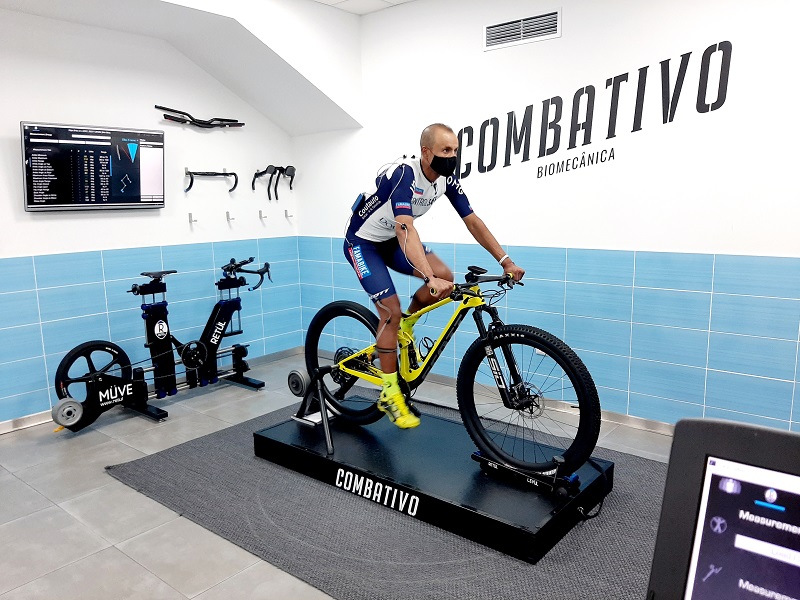
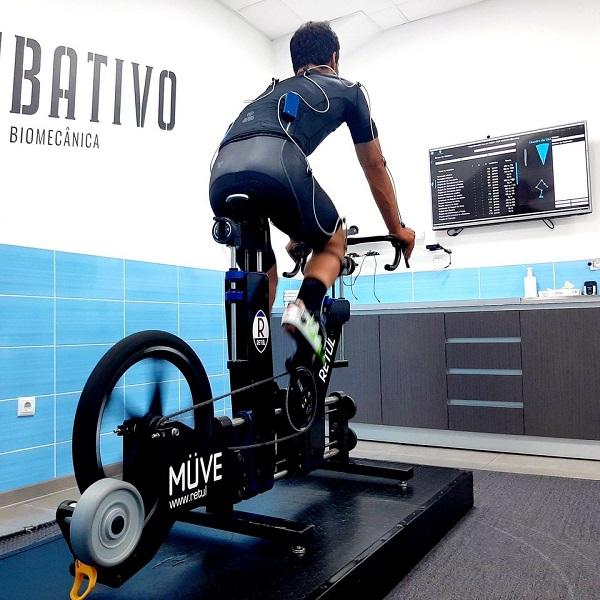
We have the Reul Muve SL system, a motorized tool that allows us to simulate all types of frame geometries for all types of bicycles, from road bikes, mountain bikes, electric bikes, gravel bikes, triathlon bikes, etc…

Graças ao inovador sistema Reul Muve SL, o avaliador poderá efetuar uma Pré Avaliação Biomecânica, onde poderá testar todas as opções de modelos de bicicletas presentes no mercado. This tool allows us to find the ideal size and model of bicycle for each athlete with great precision.
This way, you avoid purchasing a bike that is not the ideal size or model for you. Assim como gatos de extra, na compra dos componentes (avanço, espigão, selim, guiador, etc…) perfeitos para o teu enquadramento com a bicicleta.

The Biomechanical Pre-Assessment is divided into 2 phases.
Phase 1: The assessment is performed on the Reul Muve SL
-Interview with the cyclist
-Postural and physical examination of the athlete
-Placement of trigonometric technology sensors on the athlete
-Capture and analysis of the pedaling motion in 3D
-Determination of the ideal bicycle type and size for the athlete

Phase 2: The evaluation is performed directly on the athlete’s bicycle
– Placement of trigonometric technology sensors on the athlete
– Initial image capture of the pedal stroke
– 3D capture and analysis of the pedaling motion
– Cleat adjustment
– Adjustment of various bicycle components
– 3D capture and analysis of the pedaling motion
– Final image capture of the pedal stroke
– Final bicycle measurement after adjustment
– Preparation of a complete report with the final bicycle measurements.

Do you use a secondary bike on the trainer?

It’s common for most people to have one bike, a more economical one, for training on indoor trainers, especially during the winter months. This can be a big mistake, as the bike used for the trainer may not have the correct dimensions!

If the components and bicycles are not identical, it is impossible to transfer the measurements from one bicycle to another. In other words, different bicycles, different components, different measurements.

There are 3 points of contact with the bicycle: the saddle, the hands, and the feet. And as a rule, when you use a secondary bicycle for the rollers, the saddle is different, as are the handlebars and shoes.
All of these situations completely change the athlete’s relationship with the bicycle.
This can lead to discomfort in the hands, shoulders, neck, back, and feet. It can also cause injuries to the joints and, more commonly and dangerously, to the prostate.

Since training on a stationary bike typically “forces” an even more static position than usual, remaining seated for a longer period than normal can cause significant discomfort in the perineal region. In men in particular, this can result in inflammatory processes in the prostate. Estando o selim numa posição incorreta, agrava ainda mais situação.

Don’t let it get to the point of causing problems and having to resort to medical exams and consultations; resolve the situation in a healthier, more convenient, and economical way.
Talk to us; we’ll help you prevent and solve future problems!

Is it normal for the front wheel to touch the shoe?

This is a curious fact that many of you have probably wondered about.

It’s natural for your shoe to touch the front wheel of your bicycle when you’re stopped and want to make a sharp turn, accidentally touching your shoe while it’s clipped in.
While in motion, you never actually touch your shoe with the front wheel because you never make changes of direction that require such a large amount of braking.

If your shoes have markings from the front wheel, don’t worry, it’s normal!

Do you feel comfortable riding a mountain bike?

DID YOU KNOW THAT THIS IS A FALSE SENSE OF COMFORT?


“I feel uncomfortable on a road bike, but I feel good on a mountain bike!”
We hear this kind of statement very often… What’s wrong with it!

A large percentage of cyclists think they feel “good” on a mountain bike, but this is a misconception, as the riding position on a mountain bike is very unstable due to variations in terrain.

This causes the discomfort they feel to be masked as they change position.

However, the poor integration of the bicycle with the cyclist persists.

On road bikes, they feel discomfort more easily because the position is more constant. Thus, discomfort manifests itself more easily through pressure in the saddle area (pelvis or perineum); numbness in the hands or feet; pressure in the arms, shoulders and consequently in the cervical spine; back pain (lumbar and latissimus dorsi); etc… If you analyze it, you also feel some of these discomforts on a mountain bike, but these problems on a mountain bike are masked because the position is very inconsistent.

Preliminary Biomechanical Assessment / Bike Fit RETUL

The Biomechanical Pre-Assessment is recommended for those who are going to buy a new bicycle.
If you are thinking about buying a new bicycle, this is the service that meets your needs!

Thanks to the innovative Retul Muve system, the assessor can perform a Biomechanical Preliminary Assessment, where they can find out which size and model of bicycle best suits their needs. As well as the respective components, thus avoiding unnecessary extra expenses.


The Biomechanical Pre-Assessment is divided into 2 phases.

Phase 1: The assessment is conducted at Reul Muve SL.

  • Interview with the cyclist
  • Postural and physical examination of the athlete
  • Placement of trigonometric technology sensors on the athlete.
  • Capture and analysis of pedaling motion in 3D.
  • Determining the ideal type and size of bicycle for the athlete.

Phase 2: The evaluation is performed directly on the athlete’s bicycle.

  • Placement of trigonometric technology sensors on the athlete.
  • Initial image capture of the bike ride.
  • Capture and analysis of pedaling motion in 3D.
  • Cleat adjustment
  • Adjusting the various components of the bicycle
  • Capture and analysis of pedaling motion in 3D.
  • Final image capture of the bike ride.
  • Final measurement of the bicycle after adjustment.
  • Preparation of a complete report with the final measurements of the bicycle.

Biomechanical Assessment | Bike Fit | RETUL

Even today, some people are still skeptical about biomechanical assessment or bike fitting services…. It’s perfectly natural for people to have their doubts and reservations.

In the example image, and in just 4 paragraphs, we express the reflection of the results obtained through a Biomechanical Assessment with the Combativo team:

+ Health and Injury Prevention
+ Greater Comfort
+ Performance
+ Safety

We invite everyone to ask their questions without any commitment or reservation and to try our service!
www.combativo.pt/en/contacts